Adding AI to a SaaS Your Customers Already Pay For
Bolting AI into a product that already ships is a different problem from greenfield. Pricing, evals, onboarding, the failure modes. The 2026 playbook from a dozen client builds.


A client of ours runs a 14-year-old SaaS in the construction-bidding space. About 4,800 paying companies. In February we shipped the first real AI feature into the product: an "explain this bid" panel that summarizes a proposal, flags missing line items, and answers questions about it in plain language. The feature took six weeks. The thing that took six months was everything around it. Pricing it. Picking which users got it first. Writing the evals. Figuring out what to do when it was wrong. Telling the support team what to say when a customer asked if the AI was "looking at" their data.
Bolting AI into a product people already pay for is a fundamentally different problem from greenfield. The AI part is the easy part now. The product, pricing, and trust problems around it are where projects die. Here's the playbook we've been running.
The greenfield trap
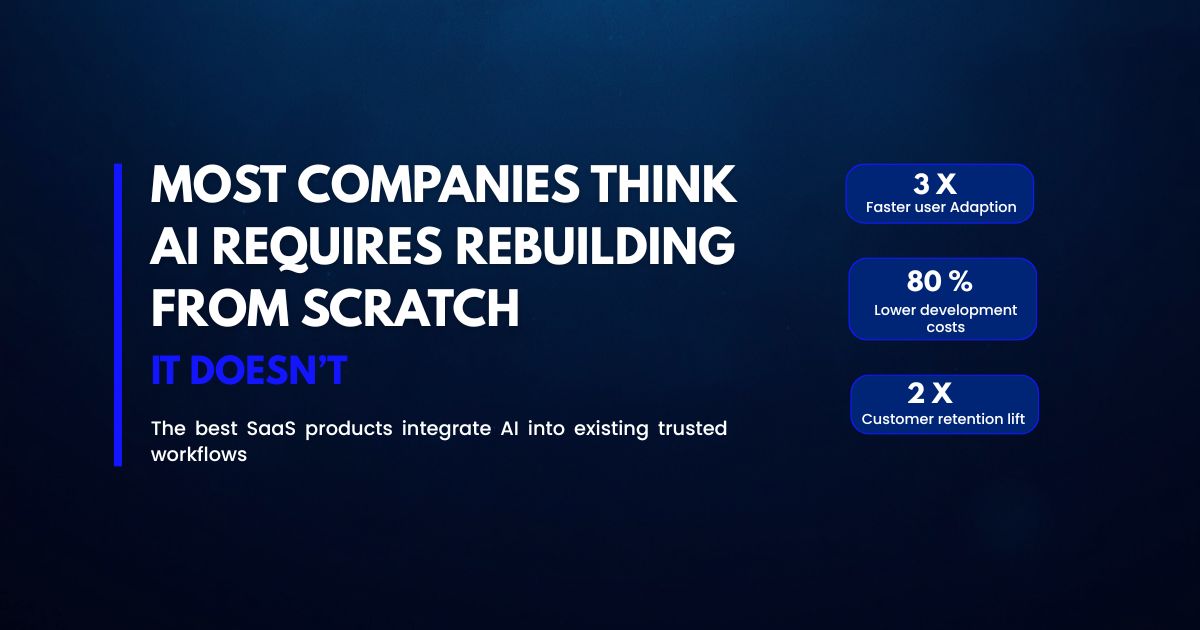
If you've only ever built net-new AI products, your instinct is wrong here. A greenfield AI product can be priced however you want, can ask the user to learn a new workflow, and has nobody who's already mad about the last thing you shipped. None of that is true when you add AI to a product that already has paying customers.
The constraints look like this. You have an existing pricing model your customers signed contracts under. You have an onboarding flow that already takes 30 days. You have a support team trained on the existing product. You have a churn rate that the AI feature can move in either direction. And you have a renewal coming up where someone is going to ask "is the AI included?"
The companies that get this right treat the AI feature as a product launch inside a product launch. Not a feature flip.
Bundle or charge extra
This is the first question every founder asks us and the one most of them get wrong.
The pattern that's working in 2026, on the projects we've watched ship and stick: bundle the basic AI feature into existing plans, charge metered or seat-based for the heavy use cases. The construction client we mentioned put the bid summarizer into the existing Pro and Business plans at no extra charge. They added a "Bid Intelligence" add-on at $40 per seat per month for the deep analysis tools (clause comparison across historical bids, win-probability scoring, market benchmarks). About 18% of Pro customers upgraded to the add-on inside the first quarter. Nobody downgraded over the bundled feature.
The mistake we see most often is treating AI as a single SKU. "AI tier" or "AI plan" pricing usually fails because the cheap AI features (summarization, search, basic Q&A) are now table stakes — your competitors are bundling them. The expensive AI features (full agentic workflows, complex analysis, document generation at scale) need usage-based pricing because cost varies 100x across customers.
The other pattern that works: a credit system for variable-cost AI features. Stripe and Linear both run versions of this. You bundle a baseline of credits, you sell more. Users feel in control of their spend. You're not exposed to a power user who runs your margin into the ground.
Some things we tell clients to avoid. Don't charge per AI message — users hate it, they ration their own usage, the feature underperforms its potential. Don't make AI a pure enterprise upsell — your SMB customers will see it on competitor sites and churn. And don't promise "unlimited AI" — someone will find a way to make that hurt.
Feature shapes that actually retain users
We've watched a lot of AI features get shipped and not used. The ones that stick share a shape.
They live inside the workflow the user was already doing. The bid summarizer doesn't have its own page. It's a panel that opens next to the bid. The HR client's "rewrite this job description" tool is a button inside the job posting editor. The accounting client's "explain this variance" lives inside the variance report. None of them require the user to leave what they were doing.
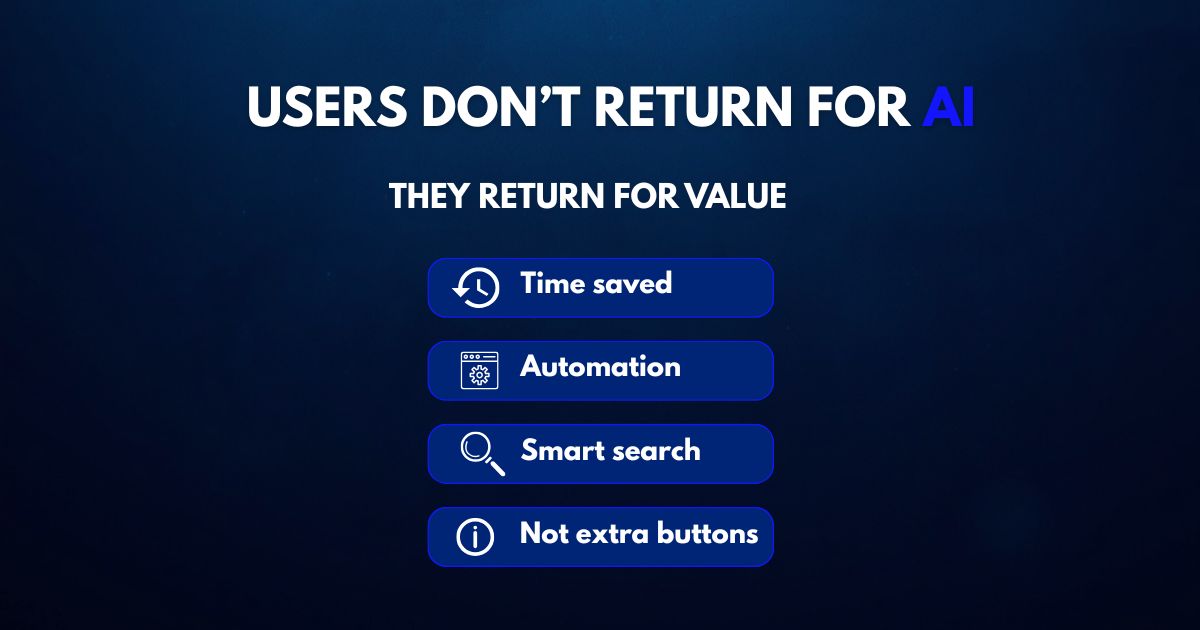
They reduce time, not add capability. The features that retain are the ones a user can describe as "the thing that does my expense report categorization now" or "the thing that drafts our customer reply." Capability features — "you can now ask anything about your data!" — get a flurry of curiosity usage in week one and then drop off a cliff. Reduction features stay used because they're load-bearing in someone's day.
They fail visibly when they fail. The single best thing we did on the construction product was the "this doesn't look right" button inside every AI output. About 4% of summaries get flagged. We feed those into the eval set. Users feel control. We get free labeled data. Trust holds.
They have a clear non-AI fallback. Every AI feature we ship has the "old way" still reachable in one click. When the model is slow, down, or wrong, the user is not stuck. This sounds obvious. We've seen multiple competing products that ship AI features as the only path, and watched their support load explode the first time the model provider had a bad afternoon.
Onboarding: the AI feature that nobody finds
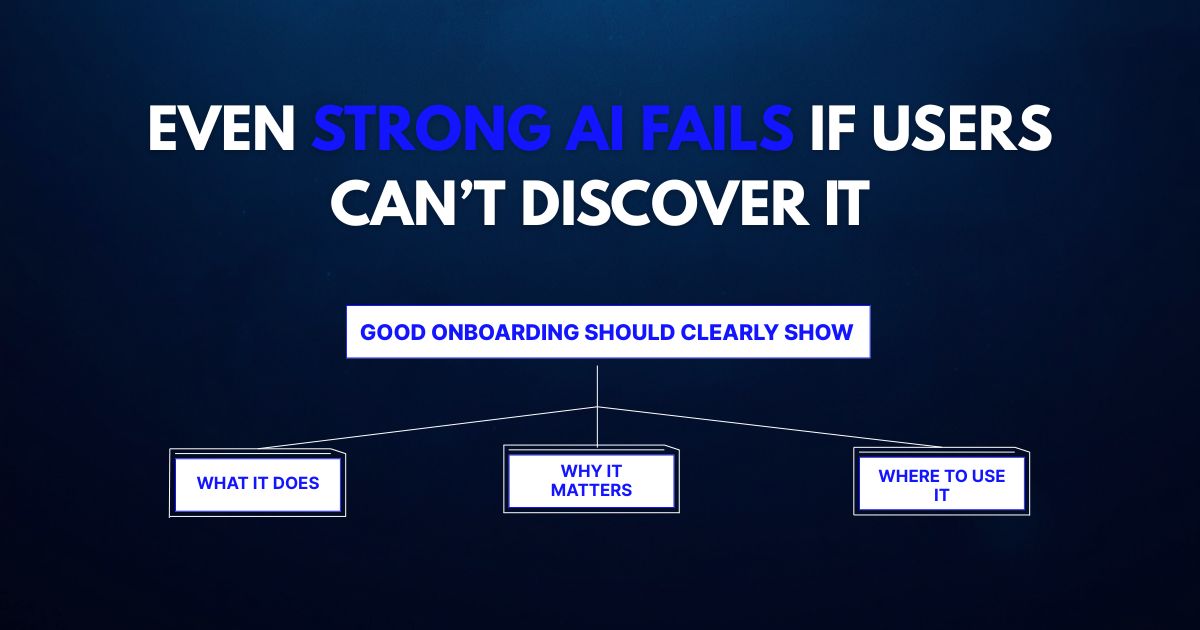
The most painful version of this we ran into last year. A SaaS client shipped an AI feature that, on actual usage analytics, 11% of paying customers found in the first 90 days. The feature was good. Nobody clicked the entry point.
The fix wasn't a bigger button. The fix was a one-time interactive walkthrough triggered the first time the user opened the relevant screen after the feature shipped, plus a single email to existing customers with a 30-second screen recording. After that rollout, discovery hit 64% inside six weeks.
For new customers, you fold the AI feature into the regular onboarding tour. For existing customers, you treat the AI launch as a re-onboarding event. Both are work. Neither is optional.
The thing nobody warns you about: existing users have habits. They have a 14-year-muscle-memory of how to do the bid summary, even when "the bid summary" was them reading the whole document. Telling them "the AI does that now" is not enough. You have to interrupt the habit at the right moment, in the workflow, with the new path visible and the old path still available.
Evals before you ship to paying customers
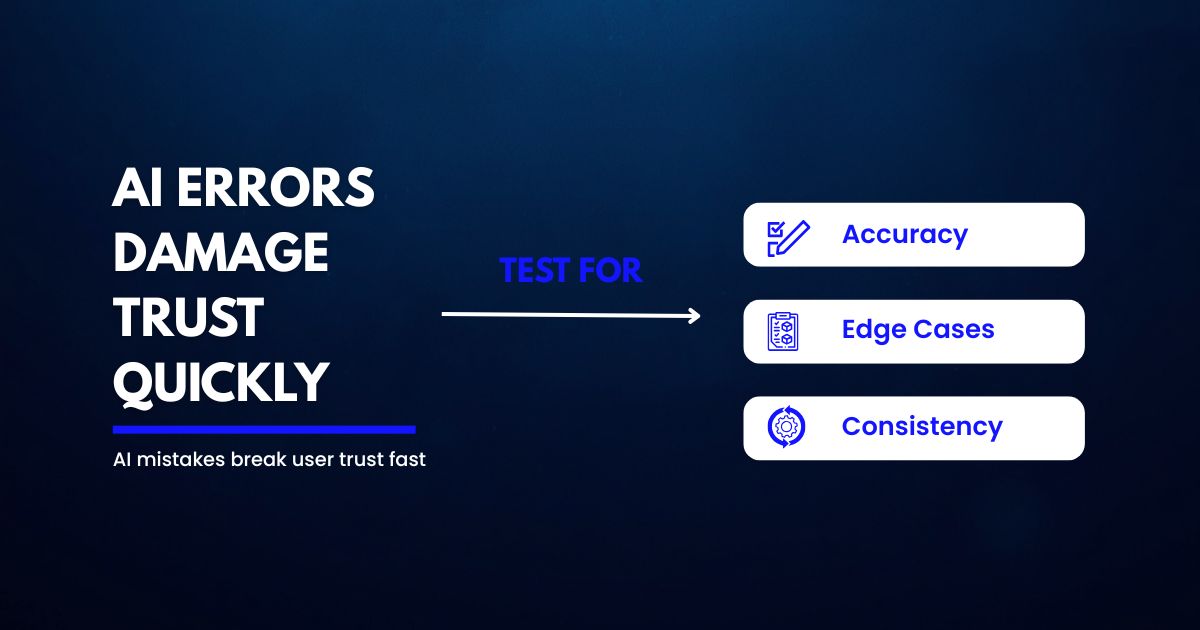
You cannot ship an AI feature to a paying customer base without internal evals. Greenfield products can get away with shipping and iterating on real traffic because nobody's promised anything yet. Existing-product AI cannot. Your customers have an expectation of correctness that the marketing site and contract already set.
What evals actually look like in practice. We pick 50 to 200 real examples from the customer's actual usage — sanitized, with permission, under the existing data terms. We label them with what "right" looks like. We run the model. We run the model again after every prompt change, model version bump, or retrieval adjustment. We track regressions.
This is not exotic. It is the work most teams skip because it's slow and unsexy. Every team that skipped it on a project we've audited regretted it later. Every team that did it caught at least one bug before customers did.
A specific number from one project: on the legal-tech client we built a clause-analysis feature for, the eval set caught a 9-percentage-point regression on a prompt change that "looked safer" to the team. Without the eval, that change would have shipped on a Friday and they'd have spent the weekend on calls.
50 labeled examples is the floor. If you can't write 50, you don't understand the feature well enough to ship it yet.
What we tell SaaS founders to start with
If you're a founder or product lead at an existing SaaS deciding what AI feature to ship first, here's the path.
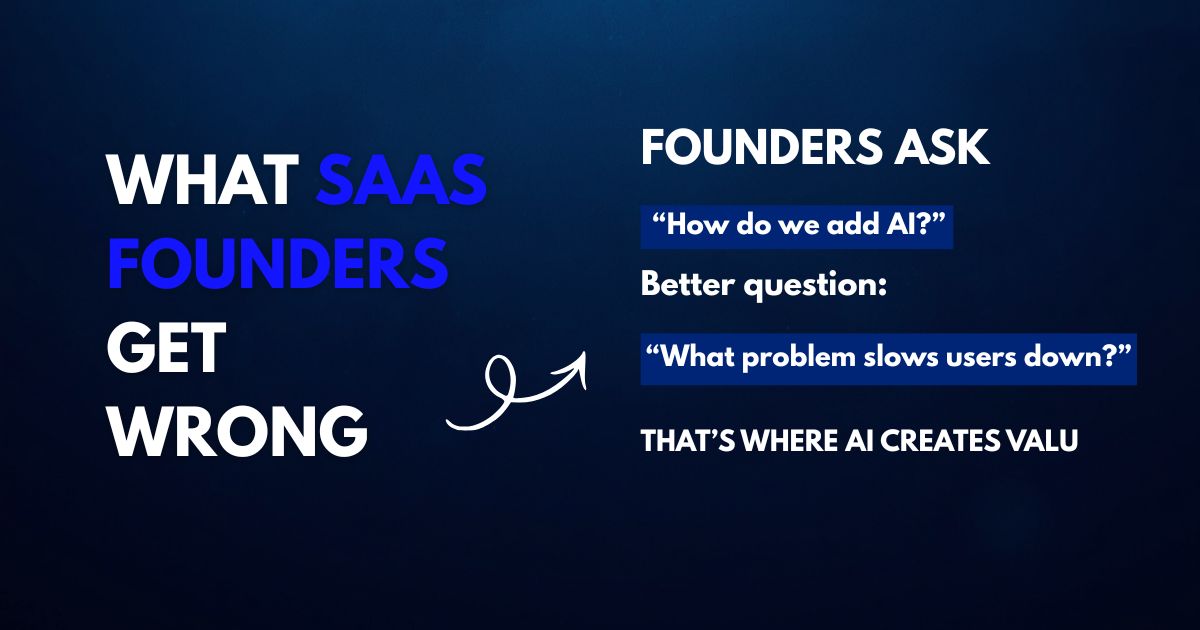
Pick the feature your power users are already manually doing in a way that's slow and error-prone. Not the feature that demos well on a sales call. The feature that quietly costs your best customers an hour a week. That's the one that retains.
Ship it to 5% of customers first. Real customers, not internal. Get logs, get feedback, fix the obvious things. Then 25%. Then everyone. The temptation to ship everywhere at once is strong. Resist it. The blast radius of an AI bug in a feature one tab over from where the money lives is bigger than you think.
Pick your model based on the eval set, not the brand. We default to Claude Sonnet 4.6 for most structured generation tasks (see eight months running Claude in production for why), but the actual decision should come from your evals.
Wire it through MCP or a thin tool layer from day one. Even if today's feature only needs your Postgres, by month four it'll want Stripe, Slack, and the CRM. The plumbing pays for itself.
Cache aggressively. Most SaaS AI features have a long stable system prompt and a short variable user prompt. That's exactly the shape that the Anthropic prompt cache (and equivalents) was built for. The 90% discount on cached input tokens is real and substantial.
Charge for it deliberately. Bundle the cheap parts, meter the expensive parts, write a credit system if your usage curve is wide.
Where this still goes wrong
Three failure modes we keep watching.
Founders ship the AI feature and don't update the contract or terms of service. Then a customer asks "wait, are you training on our data?" and the answer is awkward. The clauses you need are not hard. Get them in before you ship.
Teams pick a model provider and don't think about lock-in. We had a client who built deep into the OpenAI Assistants API in 2024 and spent most of Q1 2026 migrating off it after the API direction shifted. Build behind a thin abstraction. Don't go deep on provider-specific features unless the win is enormous and durable.
Companies under-invest in support training. The first time a customer calls in and asks "why did the AI tell me X about my bid," you do not want that to be the support rep's first time hearing about it. We write a one-page "what the AI does, what it doesn't, what to say when it's wrong" for every AI rollout. The support team rehearses it. The first week of support tickets gets reviewed daily.
The reframe that actually helps
The AI feature is not the product. The product is still the product. The AI feature is a new way that the product gets a specific job done for the user. If you stop thinking about it as "we shipped AI" and start thinking about it as "we shipped a faster way to do the bid summary," every downstream decision gets easier.
The teams that win in 2026 with AI inside an existing SaaS are not the ones with the flashiest models. They're the ones who picked the right job, priced it right, onboarded it right, and built the eval discipline to keep it honest. That's mostly product work, with some engineering. Most of it isn't AI work at all.
If you're a founder or product lead with an existing book of customers and you're trying to decide what to ship next, the AI feature isn't the hard question. The hard question is which existing job is worth automating, for which customer, at what price, with what fallback. Answer that and the model picks itself.
Got an existing SaaS and trying to figure out where AI actually fits? Book a free strategy call. We'll look at your product, your customers, and your pricing, and tell you which AI feature is worth shipping first. If none of them are, we'll tell you that too.