AI Cuts Real Estate Due Diligence Time by Up to 60%. Here's How.
72% of CRE firms now use AI for due diligence. We break down how AI actually compresses parcel research and property valuation, and where it still needs a human in the loop.

72% of commercial real estate firms have now adopted some form of AI in their workflow, and the number one use case isn't leasing or marketing. It's due diligence. Specifically, the unglamorous work of figuring out whether a parcel is worth pursuing before anyone puts money behind it.
That's not a coincidence. Due diligence is the part of a real estate deal that looks the same on every parcel: pull the flood zone data, check wetlands, check slope, check road access, check protected land status, cross-reference with utility availability, then score the whole thing. It's repetitive, it's rule-based, and it eats hours that should be going toward the next deal, not the tenth government portal login of the day.
We've built AI-assisted due diligence workflows for real estate clients, most recently a parcel intelligence platform for a portfolio-level acquisitions team. Here's what actually changes when you put AI into that pipeline, and where it doesn't.
What "AI Due Diligence" Actually Means Here
It's not an AI that decides whether to buy a parcel. It's AI doing the part of the process that used to require a human to open six browser tabs: pulling GIS layers, flagging ambiguous cases for a second look, and producing a ranked list instead of a folder of PDFs.
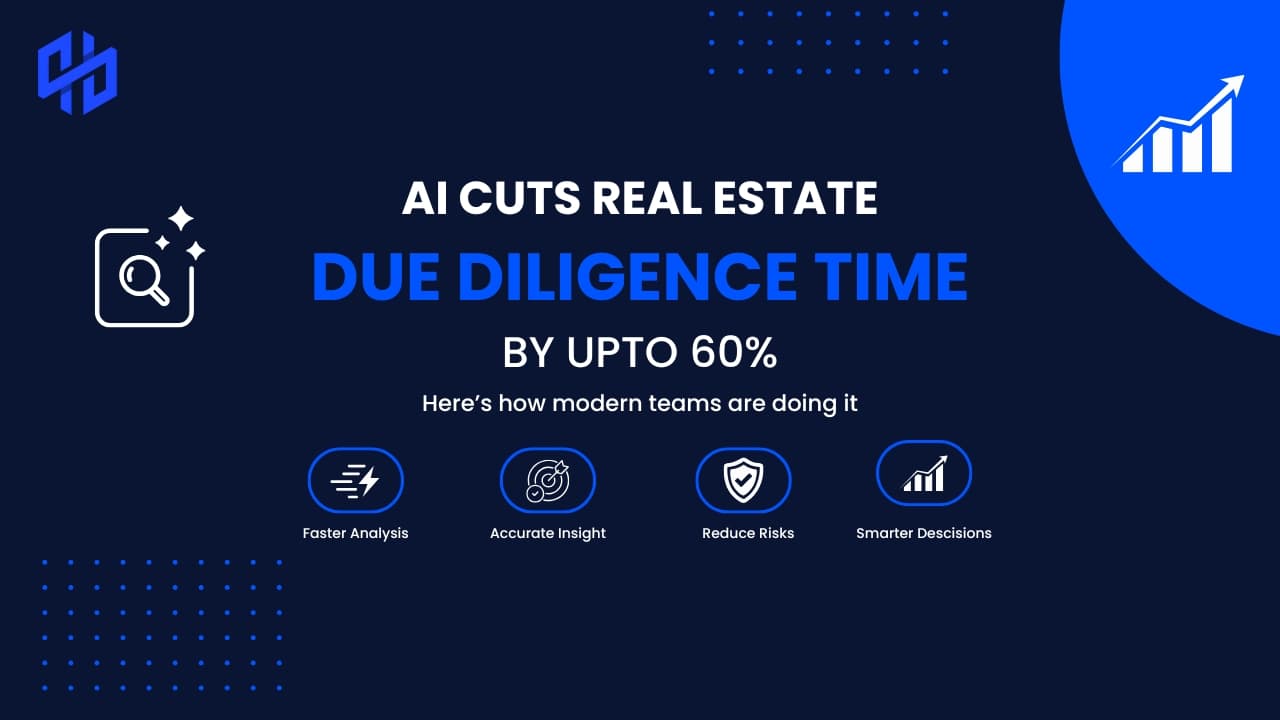
Industry numbers back up why this matters. AI-assisted due diligence is cutting review timelines by 40 to 60% compared to manual analysis, and 41% of CRE investment firms have already integrated some form of AI analytics into their acquisitions process. Property valuation specifically has seen time cuts of up to 70% where AI is layered into the comp analysis.
The Old Workflow, and Why It Doesn't Scale
Talk to any acquisitions team doing volume, dozens to thousands of parcels a cycle, and the workflow looks roughly the same everywhere:
- Pull the parcel list from a county GIS portal, one county at a time
- Cross-reference flood zone, wetlands, slope, and road access separately, often from different government sources
- Manually flag anything that looks landlocked or has an unclear utility connection
- Score each parcel by hand, usually in a spreadsheet that only one person fully understands
- Repeat the whole process for the next batch, often the next day
The problem isn't that any one step is hard. It's that the process scales linearly. Double your parcel volume, double your analyst hours. Expand into a new county, and you're relearning that county's specific portal quirks from scratch. Teams we've talked to lose 15 to 25 hours a week per analyst to exactly this loop, and the quality of the output depends heavily on which analyst did the work that day.
Where AI Actually Removes Hours
The parts of due diligence that AI handles well are the parts that are rule-based but scattered across sources. Aggregating flood, wetlands, slope, road access, and protected-land data across an entire portfolio in one pass isn't intelligence, it's plumbing, and it's exactly what used to eat the most analyst time. When that aggregation happens automatically, the analyst's job shifts from "go find this data" to "review what's already been assembled."
The second layer is where it gets more interesting: AI-driven visual and contextual review to flag ambiguous or high-risk parcels. A parcel that's technically not in a flood zone but sits adjacent to one, or a parcel with unclear road access based on satellite imagery, is exactly the kind of case a rules engine misses and a human reviewing a raw map catches too slowly to do at volume. AI models trained on that kind of visual pattern can flag it for review instead of letting it slip through or forcing a human to eyeball every single parcel.
The third layer is scoring. Once you've got clean, aggregated data and flagged ambiguities, producing a ranked, exportable view across a portfolio is something software should be doing, not a person with a spreadsheet and a Friday deadline.
Where AI Still Needs a Human, and Should
None of this replaces the acquisitions lead's judgment on whether a deal actually makes sense. AI due diligence tools are good at answering "is this parcel disqualified for a factual reason" and much weaker at answering "is this parcel worth pursuing given our current portfolio strategy." Those are different questions, and the failure mode we've seen in other teams' builds is treating AI's risk score as a purchase recommendation instead of a filter.
The other place a human still matters is owner-contact enrichment and outreach. AI can surface verified contact information fast, but compliance signals around outreach, especially across different state regulations, still need a person checking the process, not just the output. We build that checkpoint in explicitly rather than assuming the automation handles it end to end.
What Computer Vision Adds That Rules Engines Can't
A lot of the AI-in-real-estate conversation gets reduced to "the model reads the data faster." That's true but it undersells the actual shift. The bigger change is computer vision applied to satellite and aerial imagery, catching things a rules engine built on tabular flood-zone data misses entirely.
A parcel can pass every formal flood-zone and wetlands check on paper and still have an access road that washes out every spring, visible in aerial imagery but not in any government database. A rules engine checking boxes against FEMA data won't catch that. A model trained on visual patterns across thousands of similar parcels, comparing road surface, elevation change, and vegetation patterns along the access route, will flag it as worth a second look. That's the difference between AI as a faster form filler and AI as something that actually catches what the checklist was never built to catch.
This is also where platforms like Parcyl, built on top of ATTOM's property data, are pushing the category: not just aggregating known data faster, but building a feedback loop where the system gets better at flagging the ambiguous cases the more parcels it sees. That's a meaningfully different product than a dashboard that just displays flood-zone overlays faster than a government portal does.
What This Looks Like in Practice
For a real-estate client running acquisitions across multiple states, we consolidated what used to be five to six separate subscriptions and manual lookups (GIS portals, flood/wetlands checkers, a skip-trace tool, and a spreadsheet scoring system) into one pipeline. Parcel intelligence aggregation happens in one pass across the whole portfolio. AI flags the ambiguous cases. The team gets a ranked list instead of a folder of disconnected PDFs, and expanding into a new county doesn't mean relearning a new portal, because the aggregation layer already handles the new source.
The result wasn't "AI replaced our analyst." It was the analyst spending their time on the twenty parcels that actually needed judgment instead of the four hundred that didn't.
What to Actually Check Before You Buy an AI Due Diligence Tool
- Does it aggregate sources, or just summarize one? A tool that only reads one GIS layer and writes you a paragraph isn't solving the scaling problem. You need the plumbing across flood, wetlands, slope, road access, and utilities in one pass.
- Does it flag ambiguous cases, or just pass/fail everything? A binary risk score hides the parcels that actually need a second look. You want the tool surfacing "this one's unclear" as its own category.
- Can it handle your actual volume? A workflow that works for 50 parcels a month and falls over at 2,000 isn't built for how volume operators actually work.
- Is the deployment isolated to your data, or shared across a multi-tenant platform? For anyone doing proprietary deal sourcing, that distinction matters more than most vendors let on.
The teams getting real hours back this year aren't the ones chasing the flashiest AI feature. They're the ones who fixed the plumbing first.
Running due diligence across dozens or thousands of parcels a cycle and tired of stitching together five different tools? Book a free strategy call and we'll walk through what a unified AI pipeline would look like for your portfolio. See our approach to AI automation or check our work.